

Bakuchiol vs. Retinol: Benefits & Differences | PHNX Cosmetics 🐦🔥

BAKUCHIOL VS. RETINOL: IS THIS BOTANICAL INGREDIENT REALLY A NATURAL ALTERNATIVE?
The Beauty Behind the Ingredients | PHNX Cosmetics - Editorial No. 08
What if one of the most talked-about alternatives to retinol came from a plant rather than a laboratory-created vitamin A derivative?
If you've been following skincare trends, you've probably heard the name Bakuchiol.
It's become increasingly popular in serums, moisturizers, facial oils, and even makeup formulations.
Often described as a gentler, plant-derived alternative to retinol, Bakuchiol has attracted attention for its potential to improve the appearance of fine lines, uneven skin tone, and skin texture.
But is Bakuchiol actually the same as retinol?
Does it work in the same way?
And can incorporating it into makeup provide the same benefits as a dedicated skincare treatment?
At PHNX Cosmetics, we believe ingredient education should go beyond beautiful packaging and trending claims.
Let's explore the science behind Bakuchiol, where it comes from, and what makes it such an interesting ingredient in modern cosmetic formulation.
WHAT EXACTLY IS BAKUCHIOL?
Bakuchiol is a naturally occurring compound associated with the plant Psoralea corylifolia, also known as babchi.
It has a long history of use in traditional botanical preparations, although modern cosmetic Bakuchiol is typically isolated and purified for formulation purposes.
One of the reasons Bakuchiol has gained popularity is its association with retinol-like cosmetic benefits.
But here's the important distinction:
Bakuchiol is not retinol, and it is not a vitamin A derivative.
Retinol belongs to a group of compounds known as retinoids.
Bakuchiol has a different chemical structure.
Despite these differences, research has investigated whether Bakuchiol can influence some of the same skin-related processes associated with retinol.
This is where the comparison becomes interesting.
PHNX BEAUTY FACT: Bakuchiol is a distinct botanical compound. Calling it a natural retinol alternative describes its proposed cosmetic effects, not its chemical identity.
1. WHY IS BAKUCHIOL COMPARED TO RETINOL?
Retinol has been extensively studied for its role in improving visible signs of photoaging.
It can influence skin cell differentiation and processes associated with collagen production, making it a familiar ingredient in anti-aging skincare.
However, retinol can also cause irritation, dryness, peeling, and sensitivity, particularly when first introduced into a skincare routine.
Bakuchiol became an area of interest because laboratory research suggested that it may influence certain pathways associated with skin aging, despite not being a retinoid.
This led researchers to investigate whether Bakuchiol could provide visible cosmetic benefits with a different tolerability profile.
The comparison is scientifically interesting, but it doesn't mean the two ingredients are interchangeable.
2. DOES BAKUCHIOL ACTUALLY WORK?
Some clinical research suggests that Bakuchiol may improve the appearance of certain signs of skin aging.
A frequently cited randomized study published in the British Journal of Dermatology in 2019 compared twice-daily 0.5% Bakuchiol cream with once-daily 0.5% retinol cream over 12 weeks.
Both groups experienced improvements in measured photoaging outcomes, including wrinkle surface area and pigmentation.
Participants using retinol reported more scaling and stinging.
These findings are encouraging, but there are important limitations.
The study was relatively small, involved specific formulations, and lasted 12 weeks.
It doesn't establish that every Bakuchiol product is equivalent to every retinol product.
Nor does it mean that adding a small amount of Bakuchiol to any cosmetic will produce the same results.
The takeaway? Bakuchiol has promising evidence, but its effectiveness depends on the concentration, formulation, and how the product is used.
3. BAKUCHIOL VS. RETINOL: WHAT'S THE DIFFERENCE?
Although the two ingredients are frequently compared, they have several important distinctions.
Retinol
Retinol is a vitamin A derivative.
It belongs to the retinoid family and has an established role in skincare products targeting visible signs of photoaging.
Depending on concentration and formulation, it may cause dryness, peeling, or irritation.
Bakuchiol
Bakuchiol is a plant-associated compound with a different chemical structure.
It has been investigated for effects on the appearance of fine lines, pigmentation, and skin texture.
Some research suggests it may be better tolerated than retinol in certain formulations.
However, it doesn't have the same depth of clinical evidence as the broader retinoid category.
Can Bakuchiol Replace Retinol?
That depends on your skincare goals.
For someone who finds retinol difficult to tolerate, a well-formulated Bakuchiol product may be an option worth considering.
For someone seeking the more extensively studied benefits of retinoids, Bakuchiol shouldn't automatically be considered an equivalent substitute.
And neither ingredient replaces daily sun protection.
PHNX BEAUTY TIP: If you're introducing an active skincare product, begin gradually and monitor how your skin responds. A well-tolerated routine is often easier to maintain consistently.
4. IS BAKUCHIOL GENTLER ON SENSITIVE SKIN?
One of Bakuchiol's biggest selling points is its reputation for being gentle.
Some research has found fewer reports of certain irritation symptoms with Bakuchiol compared with retinol.
However, that doesn't mean Bakuchiol is incapable of causing irritation.
Even botanical ingredients can trigger sensitivity or allergic reactions.
The complete formula matters.
Fragrance, preservatives, other active ingredients, and the product's overall composition can influence tolerability.
If you have reactive skin, it's worth patch-testing new products and introducing them one at a time.
PHNX BEAUTY FACT: Natural origin does not automatically mean an ingredient is safer, gentler, or better for every skin type.
5. CAN BAKUCHIOL HELP WITH UNEVEN SKIN TONE?
Uneven-looking skin tone is one of the reasons Bakuchiol has attracted interest.
Research has explored its potential to improve the appearance of pigmentation associated with photoaging.
However, pigmentation can have many causes, including sun exposure, inflammation, and hormonal changes.
Bakuchiol isn't a guaranteed treatment for every type of discoloration.
And improvements seen with a specific clinical formulation cannot automatically be attributed to every Bakuchiol-containing product.
If uneven skin tone is a concern, daily broad-spectrum sunscreen remains especially important.
A thoughtfully selected skincare routine may help address the appearance of discoloration over time.
6. DOES BAKUCHIOL STIMULATE COLLAGEN?
Collagen is one of the proteins responsible for helping maintain the skin's structure.
As we age, changes in collagen production and breakdown contribute to visible signs of aging.
Certain laboratory studies suggest Bakuchiol may influence pathways associated with collagen-related processes.
But there is a distinction between laboratory findings and demonstrated results from finished cosmetic products.
A formulation containing Bakuchiol cannot automatically claim to increase collagen production simply because the ingredient has been investigated for that potential.
Product concentration, stability, delivery, and clinical testing all matter.
This is particularly important when Bakuchiol appears in makeup rather than a dedicated skincare treatment.
7. CAN YOU USE BAKUCHIOL DURING THE DAY?
Bakuchiol is often marketed as a daytime-friendly alternative to retinol.
Unlike some retinoids, Bakuchiol isn't generally associated with the same concerns about light-related instability.
However, the stability of any finished cosmetic product depends on its complete formulation and packaging.
And Bakuchiol does not replace sunscreen.
Even when using skincare ingredients associated with improving the appearance of photoaging, protecting your skin from UV exposure remains essential.
PHNX BEAUTY TIP: Apply broad-spectrum SPF 30 or higher as part of your morning skincare routine, regardless of whether your products contain Bakuchiol, retinol, or neither.
8. WHY IS BAKUCHIOL APPEARING IN MAKEUP?
One of the most exciting developments in the beauty industry is the growing overlap between skincare and cosmetics.
Consumers increasingly want makeup that offers beautiful colour and comfortable wear while incorporating thoughtfully selected ingredients.
This has encouraged formulators to explore ingredients traditionally associated with skincare.
Bakuchiol is one example.
Its inclusion in makeup reflects interest in multifunctional formulations that consider both cosmetic performance and skin conditioning.
But there is an important distinction between a skincare treatment and a makeup product.
A dedicated Bakuchiol serum may be formulated around a specific ingredient concentration and application schedule.
A lipstick or foundation may use Bakuchiol at a different concentration for different formulation objectives.
A makeup product containing Bakuchiol should not automatically be expected to deliver the same results as a clinically tested Bakuchiol treatment.
INGREDIENT MYTH VS. FACT
MYTH: Bakuchiol is simply natural retinol.
FACT: Bakuchiol and retinol have different chemical structures. Bakuchiol is not a retinoid.
MYTH: Bakuchiol works exactly like retinol.
FACT: Research suggests some overlapping cosmetic outcomes, but the ingredients aren't biologically or clinically identical.
MYTH: Bakuchiol never causes irritation.
FACT: Although some studies suggest favourable tolerability, irritation and individual sensitivities remain possible.
MYTH: Every Bakuchiol product reduces wrinkles.
FACT: Results depend on the formulation, concentration, application, and supporting evidence.
MYTH: Bakuchiol replaces sunscreen.
FACT: Bakuchiol does not protect skin from UV radiation and is not a substitute for broad-spectrum sunscreen.
BAKUCHIOL IN PHNX COSMETICS
At PHNX Cosmetics, we believe high-performance makeup and thoughtful ingredient selection can complement one another.
Our approach is centred on developing beautiful cosmetic formulas that consider colour payoff, texture, comfort, and skincare-inspired ingredients.
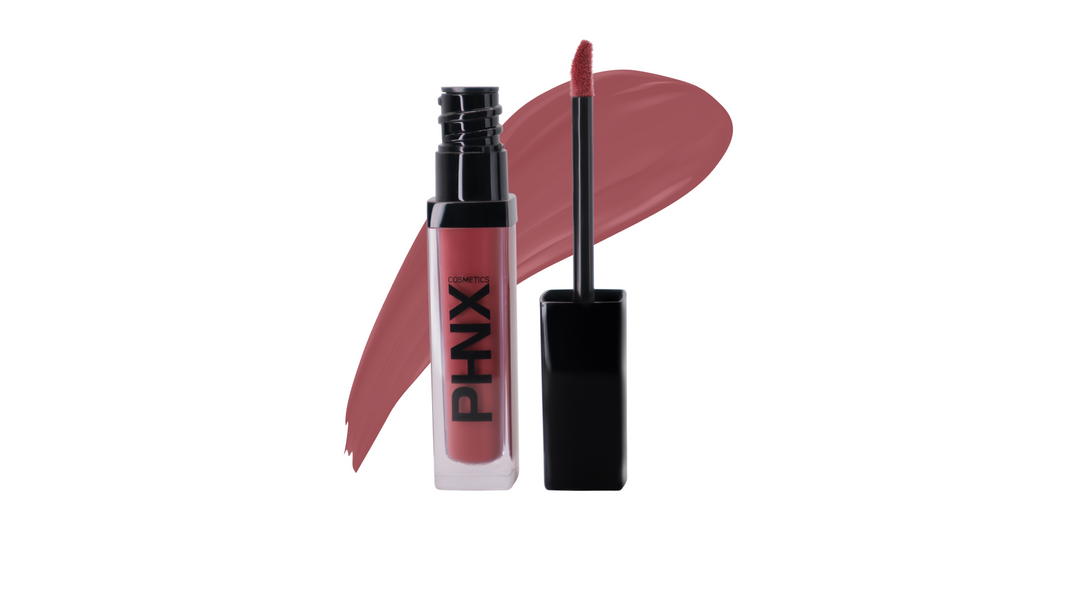
PHNX Vitamin E Lipstick
Beautifully hydrated lips are one of those beauty hacks that can completely transform your look.
Our updated PHNX Vitamin E Lipstick formulation brings together beautiful pigmentation with a selection of skincare-inspired ingredients, including:
-
Vitamin E
-
Bakuchiol
-
Niacinamide
-
Ceramide NG
-
Hyaluronic Acid
-
Peptides
Bakuchiol is included as part of this modern approach to cosmetic formulation.
Its presence reflects our interest in incorporating ingredients associated with contemporary skincare science into everyday makeup.
However, including Bakuchiol in lipstick doesn't establish that the product can reverse signs of aging or deliver the same results as a dedicated facial treatment.
Our priority remains creating lipstick that offers beautiful colour, a comfortable feel, and a polished finish.
PHNX BEAUTY TIP: For a softer, naturally enhanced lip look, apply your favourite PHNX lipstick to the centre of your lips and blend gently toward the edges. Add another layer when you want a more defined finish.
THE FUTURE OF SKINCARE-INSPIRED MAKEUP
The beauty industry has changed significantly over the years.
Today, consumers are more informed, more curious, and increasingly interested in understanding what goes into the products they use.
Ingredients like Bakuchiol are helping encourage these conversations.
But scientific education is especially important when an ingredient becomes popular.
A trending ingredient isn't automatically a miracle ingredient.
And an impressive study doesn't necessarily mean every product containing that ingredient will perform identically.
At PHNX Cosmetics, we believe beauty brands should celebrate ingredient innovation while being transparent about what the research actually supports.
Because understanding the science behind your makeup helps you make more informed decisions about the products you choose.
BEAUTIFUL MAKEUP. THOUGHTFUL INGREDIENTS.
Bakuchiol represents an interesting intersection between botanical ingredients and modern cosmetic science.
Its potential benefits have made it an increasingly popular subject in skincare research.
But perhaps its greatest contribution to the beauty conversation is reminding us that innovation should always be accompanied by education.
At PHNX Cosmetics, we're passionate about creating makeup that combines beautiful results with thoughtfully selected ingredients.
And through The Beauty Behind the Ingredients, we're continuing to explore the science behind the formulas we love.
Because beautiful makeup isn't just about the finished look. It's about understanding what goes into creating it. ✨
With love,
The PHNX Cosmetics Team
SHOP PHNX COSMETICS
Discover our collection of skincare-inspired, high-performance makeup online or at select retailers across Canada.
Website: www.phnxcosmetics.com
Instagram: @PHNXcosmetics
Clean Beauty. High Performance. Made in Canada.
From the blog
View all




Leave a comment