


Peptides in Makeup: Benefits, Myths & Skin Science | PHNX Cosmetics 🐦🔥

PEPTIDES IN MAKEUP: DO THEY REALLY WORK? THE SCIENCE BEHIND THIS POPULAR SKINCARE INGREDIENT ✨
The Beauty Behind the Ingredients | PHNX Cosmetics - Editorial No. 07
You've probably heard that peptides are the secret to younger-looking skin. But what exactly are they, and do they really deserve all the attention?
From luxury skincare serums to moisturizers and increasingly sophisticated makeup formulas, peptides have become one of the most discussed ingredients in the beauty industry.
They're often associated with collagen, skin firmness, smoother-looking fine lines, and anti-aging skincare.
But here's something many beauty lovers don't realize: not all peptides are the same, and their benefits depend on much more than simply appearing on an ingredient list.
At PHNX Cosmetics, we believe beautiful makeup begins with understanding the ingredients behind it.
Our mission has always been to combine high-performance cosmetics with thoughtfully selected, skincare-inspired ingredients.
Today, we're exploring the science behind peptides, what research tells us about their potential benefits, and why cosmetic formulators are incorporating them into modern beauty products.
Let's separate the science from the marketing.
WHAT EXACTLY ARE PEPTIDES?
Peptides are short chains of amino acids linked together by chemical bonds.
Amino acids are often described as the building blocks of proteins.
When amino acids join together, they form peptides. Longer chains can form proteins, including important structural proteins found throughout the body.
One of the most familiar examples is collagen, a protein that contributes to the structure of our skin.
But peptides aren't simply miniature versions of collagen.
Different peptides have different structures and biological functions.
Some occur naturally in the body, while others are developed for specific applications, including cosmetic formulations.
This is what makes peptides such an interesting category of ingredients.
PHNX BEAUTY FACT: The word peptide describes a broad family of molecules. Two products containing different peptides may have entirely different intended functions.
1. WHY ARE PEPTIDES USED IN SKINCARE?
Peptides have attracted attention because certain types can interact with biological processes involved in skin function.
Researchers have investigated specific cosmetic peptides for potential effects on the appearance of fine lines, skin texture, and firmness.
Some are designed to act as signaling molecules, while others have different proposed mechanisms.
However, there is an important distinction between what a peptide may do in laboratory research and what a finished cosmetic product can achieve on human skin.
For a topical peptide to have a meaningful biological effect, factors such as stability, skin penetration, concentration, and formulation all matter.
This means the presence of a peptide doesn't automatically establish that a product can stimulate collagen production or visibly reduce wrinkles.
The takeaway? Peptides are scientifically interesting, but their benefits must be evaluated individually.
2. DO PEPTIDES ACTUALLY BOOST COLLAGEN?
This is probably the most common claim associated with peptides.
Collagen is a structural protein found in the skin's dermis, where it contributes to strength and support.
As we age, changes in collagen production and breakdown contribute to visible changes in skin texture and firmness.
Certain peptides have been studied for their potential to influence pathways associated with collagen synthesis.
For example, some signal peptides are designed to interact with processes involved in the skin's extracellular matrix.
However, results vary depending on the specific peptide and the quality of the research.
Evidence from a laboratory experiment doesn't necessarily mean a cosmetic product will produce the same results when applied to skin.
And a product containing peptides shouldn't automatically be described as collagen-boosting without appropriate supporting evidence.
PHNX BEAUTY TIP: If maintaining youthful-looking skin is your goal, don't overlook daily broad-spectrum sunscreen. Protecting your skin from UV exposure is one of the most established ways to help prevent premature photoaging.
3. ARE ALL PEPTIDES THE SAME?
Not at all.
One of the most important things to understand is that peptides are a diverse group of ingredients.
In cosmetic science, they're sometimes categorized according to their proposed functions.
Signal Peptides
Certain signal peptides are investigated for their potential influence on processes involved in skin structure and the extracellular matrix.
Their effects depend on the specific peptide and formulation.
Carrier Peptides
Some peptides are designed to bind or transport substances such as metal ions.
Copper-containing peptides are one example studied in skincare research.
Neurotransmitter-Related Peptides
Certain cosmetic peptides are marketed for their proposed influence on processes associated with expression lines.
However, topical cosmetic peptides should not be confused with injectable neuromodulator treatments.
Their mechanisms, delivery methods, and demonstrated effects are not equivalent.
Other Functional Peptides
Additional peptides may be incorporated into cosmetics for conditioning or other formulation-related purposes.
The important point is that you cannot determine what a peptide does simply from the word "peptide" on the packaging.
You need to know which peptide is present and what evidence supports its intended use.
4. CAN PEPTIDES PENETRATE THE SKIN?
This is one of the biggest challenges in topical peptide formulation.
Your skin barrier is designed to limit the movement of many substances into the body.
While this is essential for protection, it also means that certain cosmetic ingredients may have difficulty penetrating beyond the outermost layers of skin.
Peptides vary in molecular size, charge, and chemical structure.
These properties influence how they interact with the skin.
Some peptides are modified to improve their stability or compatibility with cosmetic delivery systems.
Others may remain primarily near the skin's surface.
This is why cosmetic chemists pay close attention to formulation technology.
A peptide's presence in a product doesn't guarantee that it reaches the skin layers where a proposed biological effect would occur.
5. PEPTIDES VS. COLLAGEN: WHAT'S THE DIFFERENCE?
Peptides and collagen are closely related, but they aren't interchangeable.
Collagen is a large structural protein naturally found in the skin and other connective tissues.
Peptides are shorter chains of amino acids that can have many different functions.
When collagen is hydrolyzed, it's broken down into smaller fragments, often called collagen peptides.
But not every cosmetic peptide is derived from collagen.
Likewise, applying collagen-containing skincare doesn't mean that intact collagen will become part of your skin's existing collagen network.
In topical cosmetics, collagen and collagen-derived ingredients can contribute to hydration, film formation, and skin conditioning, depending on the formula.
Certain specialized peptides are studied for additional biological effects, but those benefits must be supported by evidence.
PHNX BEAUTY FACT: Peptides, collagen, and amino acids are related concepts, but each refers to something different in cosmetic chemistry.
6. CAN PEPTIDES BENEFIT YOUR LIPS?
Peptides aren't limited to facial skincare.
They can also be incorporated into lip products, including treatments, balms, and lipsticks.
Depending on the specific peptide, formulators may use them as part of a broader skin-conditioning or appearance-focused formulation.
However, claims that a peptide lipstick can permanently plump lips, stimulate substantial collagen production, or reverse lip aging require strong supporting evidence.
The immediate appearance of smoother, fuller-looking lips is often influenced by the complete product, including its emollients, pigments, shine, and film-forming ingredients.
And that's an important distinction.
Beautiful lip makeup can combine thoughtful ingredients with a flattering cosmetic finish without promising medical or permanent structural changes.
7. ARE PEPTIDES SUITABLE FOR SENSITIVE SKIN?
Many peptide-containing cosmetic products are designed for a variety of skin types.
However, the word peptide doesn't automatically mean a product is gentle or suitable for everyone.
Individual sensitivities are possible, and the complete formulation matters.
A product may contain peptides alongside fragrances, preservatives, exfoliating ingredients, or other components that influence tolerability.
If your skin is reactive, consider introducing new products gradually and paying attention to how your skin responds.
PHNX BEAUTY TIP: When evaluating a new cosmetic product, look beyond the highlighted ingredient on the front of the packaging. The full formula is what ultimately determines your experience.
INGREDIENT MYTH VS. FACT
MYTH: All peptides stimulate collagen production.
FACT: Different peptides have different functions. Some have been studied for effects on collagen-related pathways, but those findings cannot be applied to every peptide.
MYTH: Peptides work exactly like Botox.
FACT: Topical cosmetic peptides are not equivalent to injectable neuromodulators, and claims of comparable effects are not established.
MYTH: More peptides automatically mean better results.
FACT: The identity, concentration, stability, delivery system, and supporting evidence for each peptide are more important than the number listed in a formula.
MYTH: Peptides and collagen are the same thing.
FACT: Peptides are shorter amino acid chains, while collagen is a large structural protein.
MYTH: A lipstick containing peptides permanently plumps your lips.
FACT: Permanent lip-plumping claims aren't established simply by including peptides in a cosmetic formulation.
MYTH: Peptides are only useful in anti-aging products.
FACT: Peptides are a broad category of ingredients with different possible cosmetic functions, including conditioning applications.
PEPTIDES IN PHNX COSMETICS
At PHNX Cosmetics, we're passionate about developing makeup that combines beautiful pigmentation, comfortable textures, and thoughtfully selected ingredients.
As beauty and skincare continue to overlap, peptides represent an interesting area of cosmetic formulation.
PHNX Vitamin E Lipstick
Your lip balm is one of the beauty products you may reach for several times throughout the day.
That's why we believe the overall formula should be considered!
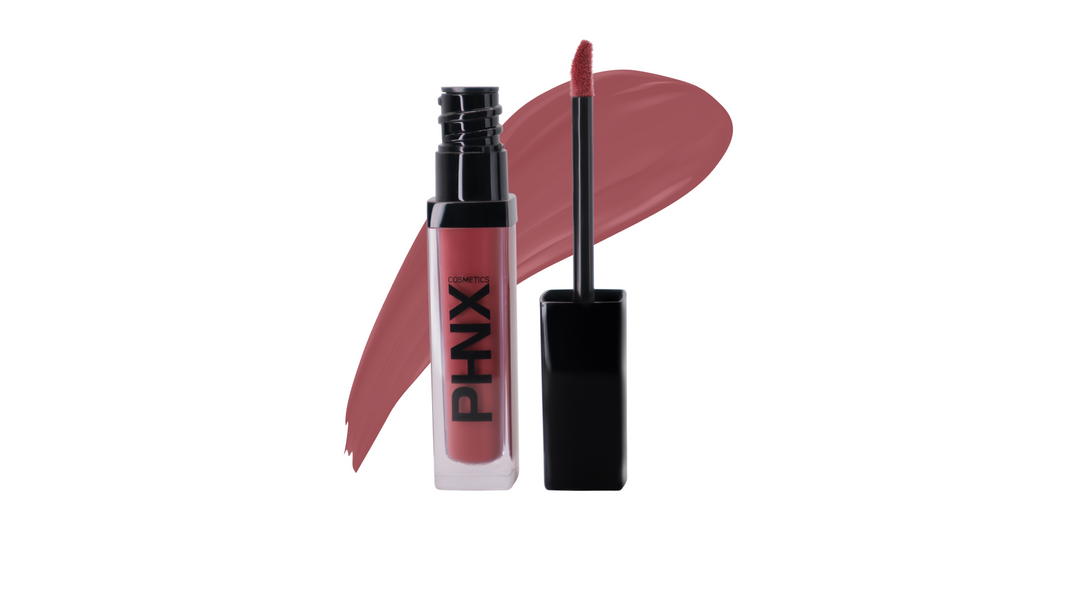
Our updated PHNX Vitamin E Lipstick formulation incorporates peptides alongside skincare-inspired ingredients including Vitamin E, Hyaluronic Acid, Niacinamide, Ceramide NG, and Bakuchiol.
These ingredients reflect our approach to developing modern lip makeup that considers colour, texture, and the overall wearing experience.
Peptides are included as part of this skincare-inspired formulation philosophy.
However, the presence of peptides alone doesn't mean a lipstick has been clinically demonstrated to increase collagen or permanently change lip volume.
Our goal is to create beautifully pigmented lipstick with a comfortable feel and a polished finish.
PHNX BEAUTY TIP: For a smoother-looking lip finish, begin with moisturized lips, PHNX Vitamin E Lipstick is a great choice, then apply your lipstick in thin layers, and gently blot before adding a second layer of colour.
WHY PEPTIDES REPRESENT AN EXCITING AREA OF COSMETIC SCIENCE
One of the most fascinating things about the beauty industry is how quickly formulation science continues to evolve.
Consumers are increasingly interested in products that do more than provide colour.
They want to understand how ingredients are selected, how they function, and what benefits they can realistically offer.
Peptides are a perfect example of why this education matters.
They represent a diverse and scientifically interesting category of molecules.
Some have promising research behind specific applications, while others require further investigation.
At PHNX Cosmetics, we believe ingredient education should celebrate scientific innovation without exaggerating what a product can achieve.
Because thoughtful formulation and transparency are just as important as beautiful makeup performance.
THE FUTURE OF BEAUTY IS SCIENCE-LED
Peptides may be one of the most exciting categories in modern skincare, but understanding their limitations is just as important as understanding their potential.
Not every peptide is the same.
Not every formulation delivers the same results.
And no single ingredient can replace a complete skincare routine.
At PHNX Cosmetics, our philosophy is to bring together beautiful makeup and thoughtfully selected, skincare-inspired ingredients.
Through The Beauty Behind the Ingredients, we're continuing to explore the science behind the products we love.
Because informed beauty choices begin with curiosity, transparency, and education.
Beautiful makeup is about more than what's on the surface. It's about understanding the science behind every formulation. ✨
With love,
The PHNX Cosmetics Team
SHOP PHNX COSMETICS
Discover our collection of skincare-inspired, high-performance makeup online or at select retailers across Canada.
Website: www.phnxcosmetics.com
Instagram: @PHNXcosmetics
Clean Beauty. High Performance. Made in Canada.
From the blog
View all




Leave a comment